

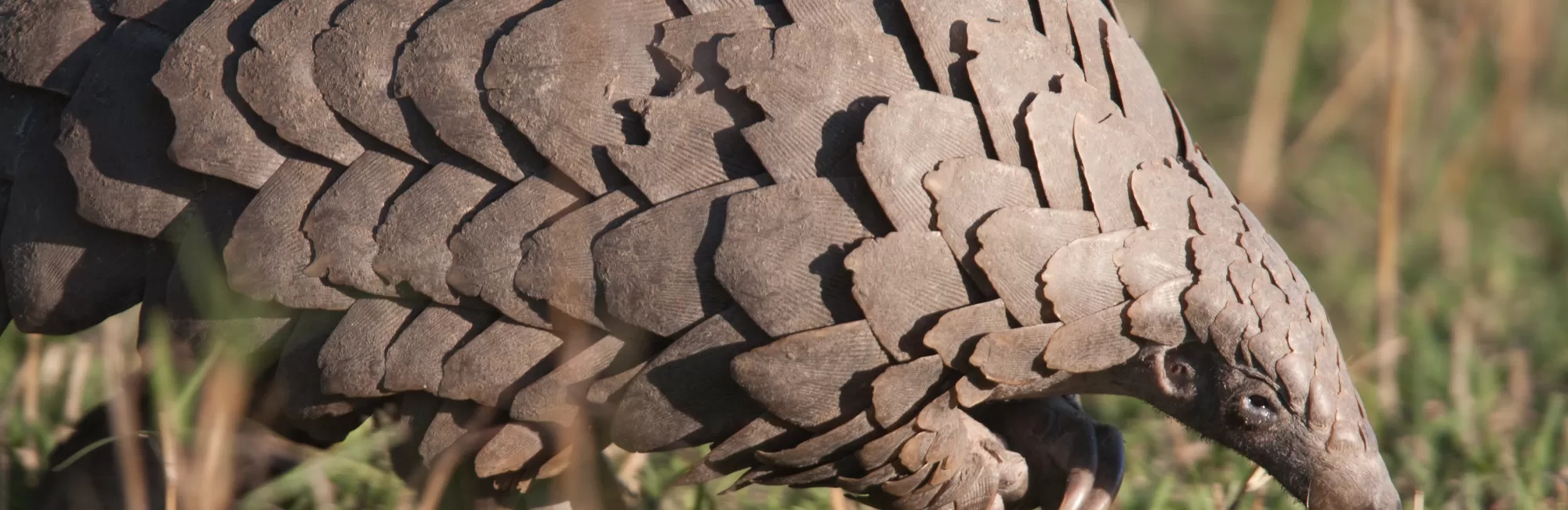
Pangolins are the world’s most heavily-trafficked wild mammals
Pangolins, also known as scaly anteaters, are reclusive and nocturnal animals that roll up into a ball when threatened. They are seldom seen in the wild, and are very hard to raise in captivity. Yet, pangolins have become the most heavily trafficked wild mammal in the world. Up to 200,000 are estimated to be taken from the wild every year across Africa and Asia. Their meat is considered a delicacy by some in Africa, China, Vietnam, while tjeoir scales have also been widely used in Traditional Medicine in Asia. Although their scales are made of keratin -- the same protein found in human nails and hair -- and there is no scientific evidence they convey any medical benefit, they are used to treat a range of ailments from arthritis to cancer.


A disaster for pangolins across the globe
These twin threats had disastrous effects on pangolin populations, initially and most markedly in Asia. Then, as Asian pangolin populations began to vanish, hunters and traffickers turned their attention to Africa. In recent years Cameroon has emerged as a major source of pangolin scales trafficked to Asia, while Nigeria has become a major transit and export hub.
In early 2017, all eight pangolin species gained full protection from cross-border commercial trade under international law. However, illegal trade has continued, and in 2019 the International Union for Conservation of Nature (IUCN) declared that the status of three of the eight pangolin species has worsened in its update to the Red List of Threatened Species: Two African pangolin species, the White-bellied and the Giant Pangolin, moved from the “Vulnerable” to “Endangered” category alongside the Indian Pangolin, while the Philippine Pangolin moved from “Endangered” to “Critically Endangered,” joining the Sunda and Chinese Pangolins.
200,000
Each year, up to 200,000 pangolins are poached from the wild.
300+
WildAid and our partners have trained more than 300 law enforcement specialists to interdict pangolin shipments.
8
There are 8 species of pangolins, 4 are found in Africa and 4 in Asia, all are under threat and all are now protected from international trade.
Making an impact
WildAid has been on the front lines of the fight for pangolins, launching its first public awareness campaign in 2016, which aimed to eliminate demand for pangolins in the world’s two largest markets – China and Vietnam – through behavior change campaigns designed to educate consumers and make consumption of pangolin products socially unacceptable. Enlisting the power and reach of legendary ambassadors like Jackie Chan and China’s superstar Angelababy, and working closely with government and media partners, we reached some 800 million viewers in these countries with our messaging across dozens of TV networks and on over 160,000 video screens in subways, airports, bus stops, hospitals and shopping centers.
Finally, reasons for hope
A 2015 WildAid survey found that 70% of respondents in China believed pangolin scales had medicinal value. Eighteen months after launching our campaign, this figure had dropped by more than 28%.
In 2020, China increased protection for the native Chinese Pangolin to the highest level, reinforced a ban consumption of pangolin meat along with a ban on all wildlife consumption as food, and removed pangolin scales from a list of approved ingredients to be used in Traditional Chinese Medicine. Loopholes in policy and enforcement remain and scales are still widely used and freely advertised by pharmaceutical companies, but finally there is reason to believe we are turning the corner.
WildAid's consumer research is showing evidence of a significant decline in demand for products using pangolin scales in China, especially among young people. This in turn is already having an impact in Cameroon, where the price of pangolin scales fell by between 45% and 75% across urban and rural areas between 2020 and 2025.
WildAid is also tackling the demand for pangolin meat in Cameroon, which has emerged as an equally serious threat to the survival of these shy animals.
That campaign is also already yielding results and bringing hope. Between 2022 and 2024, WildAid research showed a 25% drop in reported consumption of pangolin meat in Cameroon's cities. Since then, 150 restaurants that serving pangolin meat in five cities and towns have publicly pledged to take it off the menu.
Facts about pangolins
- Pangolins are the only mammals with large scales covering their skin, apart from their bellies. Their scales are made of keratin, the same material as in human hair and nails and animals’ claws.
- When they feel threatened, they roll up into a ball, just like hedgehogs and armadillos. The word pangolin comes from the Malay word “penggulung” which means roller. The strategy works against animal predators – not even a lion can bite through the scales – but is useless against poachers.
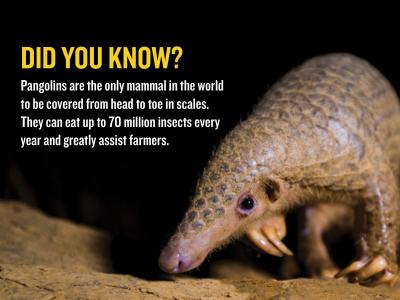
- Pangolins are nocturnal animals, feeding on ants, termites and their larvae. They don’t have teeth. Instead, they use their powerful claws to dig into anthills, and their long, sticky tongues to scoop up the ants. While they eat, the close their ears and nostrils to keep the ants out. They can eat 20,000 ants a day, or 70 million a year.
- They are more closely related to bears, cats and dogs than to armadillos and anteaters.
- Female pangolins keep their young in burrows until they are old enough to ride on their mother’s tail.
- Some pangolins have prehensile tails that help them climb trees or hang from branches.
Pangolins in African culture
In Zimbabwe, the indigenous VaJindwi people believe pangolins are sacred animals, and just seeing one can bring good luck – one year of good fortune for each step the animal is seen to take. It’s a taboo to harm pangolins, and any attempt to sell one for profit would bring bad luck – as well as attract a fine from the village chief.

The Paul Biya Omnisports Stadium in Yaoundé, Cameroon which hosted the African Cup of Nations football tournament in 2022. The exterior design represents pangolin scales.