

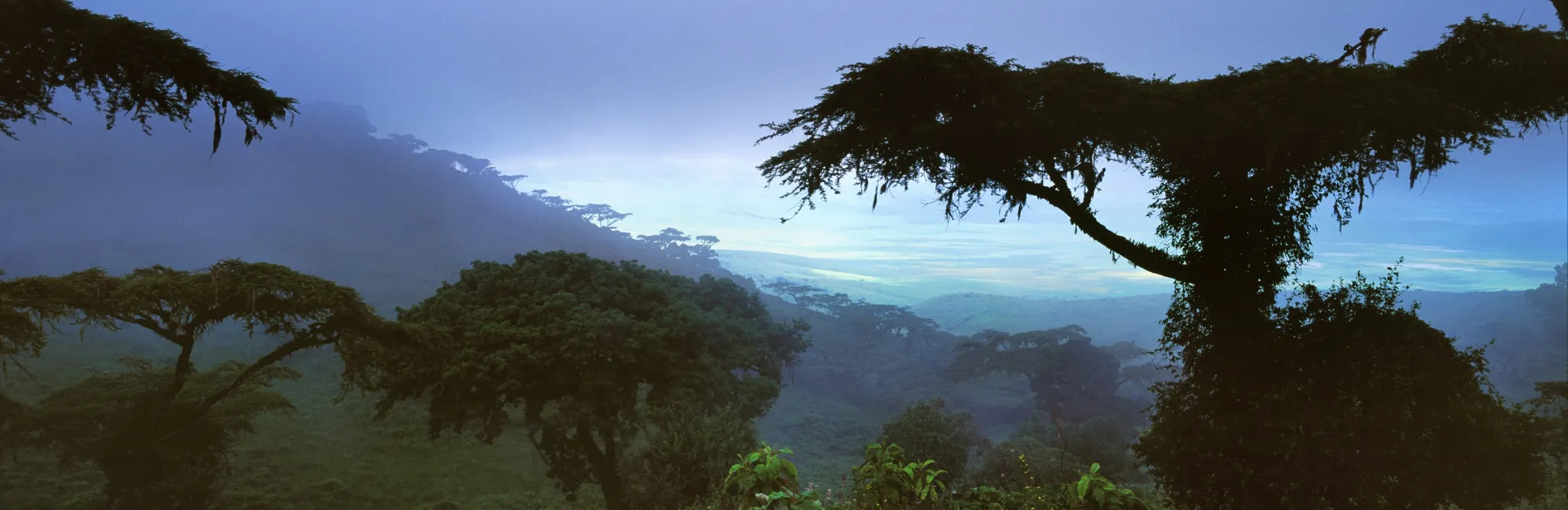
WildAid's work across the Cameroon and Gabon targets the heart of Earth's second-largest tropical rainforest. Often called one of the planet’s "green lungs," the Congo Basin ecosystem plays a critical role in global climate stability and is home to some of the world's richest biodiversity.
Global carbon anchor: The Congo basin has surpassed the Amazon as the world's largest remaining tropical carbon sink, sequestering roughly 600 million tonnes of carbon dioxide out of the atmosphere every year, and acting as a store for between 60 and 80 billion tonnes of carbon across its lush vegetation and massive underground peat systems.
Climate regulator: The vast forest regulates climate across the continent, stimulating rainfall that is vital for agriculture. Deforestation is already threatening rainfall, water availability and farming.
Biodiversity bastion: The region holds 20% of the world’s biodiversity, including at least 3,000 endemic plant species and more than 1,200 different species of river fish. It is the only home of the critically endangered African Forest Elephant, as well as Western Lowland Gorillas, Chimpanzees, Bonobos, and the elusive Okapi.
Pangolin stronghold: It serves as a vital refuge for three of Africa’s four species of pangolins —the world's most trafficked wild mammal.
Urgent threats
Two main threats run across the region.
The wild meat crisis: A booming commercial, urban market for illegal wild meat directly threatens vulnerable populations of primates, pangolins, and forest ungulates.
Forest degradation: Rapid canopy loss driven by illegal logging, mining, charcoal production and unsustainable agricultural encroachment is stripping away critical habitats.
Yet within that overall framework lies some very different countries with very different experiences in the past quarter century.
Gabon is one of the most densely forested countries on Earth, with nearly 90% of its land mass covered by trees. It sustains roughly two-thirds of Africa’s remaining forest elephants, as well as gorillas, hippos, chimpanzees, and pangolins. Yet it is not immune from the pressures of illegal logging, poaching and unsustainable wild meat consumption. Between 2002 and 2025, Gabon lost around 1% of its humid primary forest, according to Global Forest Watch.
Cameroon also has some of the richest forested areas in West and Central Africa, home to numerous endemic and endangered species and numerous communities that depend on these areas for livelihoods, resources and sustenance. Yet these forests have been vanishing at an alarming and accelerating rate since 2013. Illegal logging to satisfy Asian demand, fueled by corruption, saw Cameroon lose 6% of its humid primary forest between 2002 and 2025, according to Global Forest Watch, with land clearance for agriculture, plantations, roads and mining also contributing to deforestation. At the same time, hunting for the wild meat trade is placing an unsustainable burden on many animal species, especially pangolins.
WildAid's approach
WildAid works in Cameroon and Gabon to support community-led conservation and reduce urban demand for wild meat, concentrating on protected species.
In Cameroon, WildAid's work is centered on reducing urban demand for pangolin meat, and bolstering efforts to prevent the trafficking of pangolin scales to Asia.
Our campaign, led by Cameroonian traditional leaders, musicians, footballers and other influencers, has already had dramatic results, with support for pangolin protection rising, consumption of pangolin meat falling and moire than 150 urban restaurants agreeing to take pangolin off the menu.
Read more about our work in Cameroon here.
In Gabon, WildAid works with Conservation Justice and Brainforest Gabon to mobilize communities living within and alongside forests to take action to conserve natural resources.
We educate forest-adjacent communities about laws and regulations, about their rights and responsibilities, about sustainable resource use and about conservation. The aim is to help communities benefit from their environment in a sustainable manner, and to foster community pride in preserving natural resources, so that environmental crimes gradually become socially unacceptable.
Working with the government of Gabon, we are also in the process of establishing a nationwide toll-free reporting hotline to allow these communities to report environment crime and suspicious activity in their forests.
Read more about our work in Gabon here.