

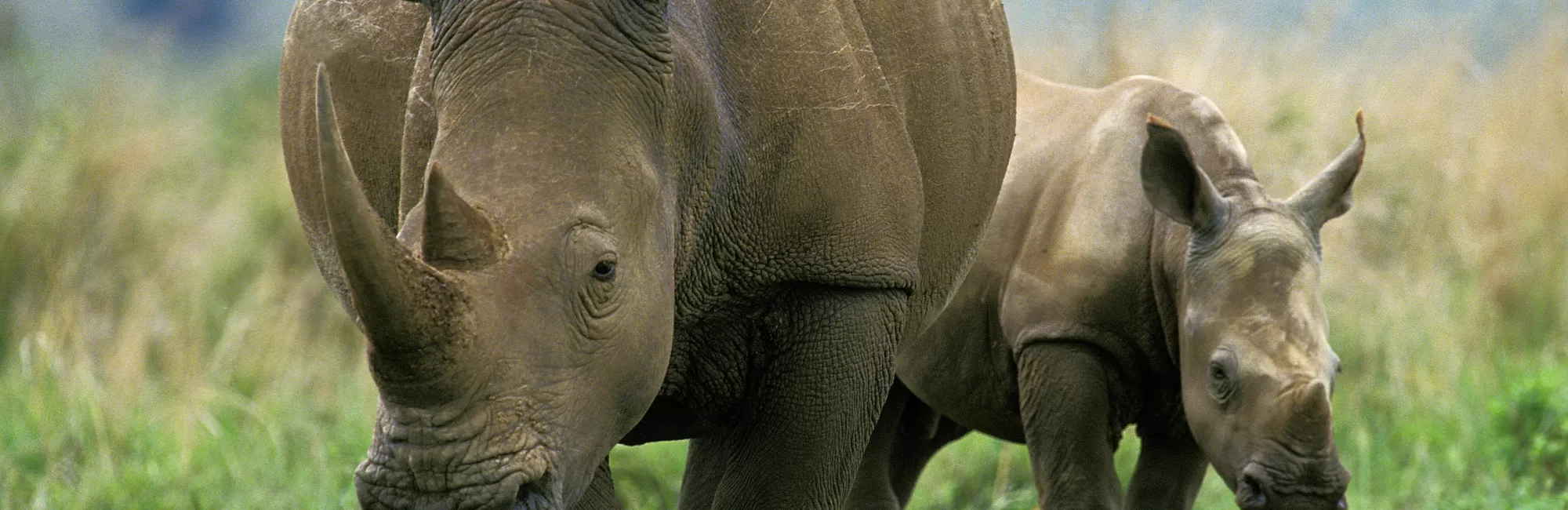
Rhinos pushed close to extinction by poaching crisis
At the start of the 20th century, around half a million rhinos roamed Africa and Asia. Today, fewer than 27,000 remain. The collapse was initially driven by habitat loss and unregulated hunting, but more recently by an unprecedented surge in poaching, primarily to satisfy demand for rhino horn for use in traditional medicine in China and Vietnam.
Although China banned the domestic trade in rhino horn in 1993, consumption of rhino horn continued to surge there and in Vietnam, where it is promoted as a purported cancer cure, general health tonic and hangover cure. At the height of the crisis between 2013 and 2017, three rhinos were being killed every day -- with 1,349 killed in 2015 alone, most of them in South Africa.
Primarily composed of keratin, the same protein found in human hair and fingernails, rhino horn has no unique medicinal properties. WildAid works to raise awareness in Vietnam and China of the rhino poaching crisis, support the strengthening of enforcement efforts, and to reduce demand for rhino horn.
Making an impact
To address demand for rhino horn, WildAid has long campaigned to debunk the myths about rhino horn’s curative properties.
In 2026, the Coalition for Wildlife Protection in TCM, in collaboration with WildAid and Choice, launched “The Practitioner’s Dilemma.” The campaign calls on the traditional medicine community to help raise awareness and abandon the use of rhino horn in treatments.
“The Practitioner’s Dilemma” aims to debunk persistent myths that rhino horn can cure cancer, treat strokes, or soothe hangovers — claims unsupported by both traditional and modern medicine. At the same time, the campaign encourages the use of herbal alternatives that are more effective, affordable, legal, and humane.
Historically, some medicinal ingredients derived from wildlife were used when treatment options were limited and medical knowledge was less advanced. Today, science has progressed, and effective herbal alternatives are increasingly abundant and accessible. Continuing to use wildlife products is no longer necessary.
At the heart of the campaign is a public service announcement that illustrates the evolution of traditional medicine. Through two contrasting settings, it depicts a physician of the past, constrained by limited treatment options and viewing rhino horn as the only solution, alongside a modern practitioner with access to a wide range of herbal alternatives that are effective, affordable, legal, and humane.
The campaign calls on everyone to take action by signing the pledge to reject rhino horn and choose herbal alternatives instead. Together, we can help end rhino poaching and consumption and build a future where people and nature thrive side by side.
Previous campaigns
Working with influential public figures in Vietnam and China, and in partnership with the African Wildlife Foundation, we raised public awareness about the realities of rhino horn. In partnership with the Ho Chi Minh City Health Department, we produced messages with traditional medicine doctors speaking out against the use of rhino horn. Additionally, 100 top Vietnamese CEOs have signed our pledge never to buy, use or sell rhino horn,
Our 2016 survey in Vietnam found a 67% decline from 2014 in the number of people who believe that rhino horn has medicinal effects.
Knowledge that rhino horn is composed of substances found in hair and fingernails increased drastically by 258% from 19% in 2014 to 68% in 2016. Over half of the respondents said they’d heard rhino protection messages in the past year and 99% agree that the messages are useful and discourage people from purchasing rhino horn.
In 2018 Vietnam significantly strengthened penalties for illegal wildlife trafficking, making the commercial sale, storage, and transport of endangered species products like rhino horn a serious criminal offense with lengthy prison sentences.
Strengthened law enforcement efforts and a dehorning program have helped to reduce rhino poaching significantly from their peak. Yet in 2025, 352 rhinos were still killed in South Africa, and poaching remains an existential threat to all five rhino species.
Rhino facts
- In 2011, the western black rhino was declared extinct. The northern white rhino is also teetering on the brink of extinction, with just two females living under constant guard in Kenya’s Ol Pejeta Conservancy.
- There are five species of rhino, three of which are critically endangered: the black rhino found in Africa, and the Javan and Sumatran rhinos found in Indonesia. But conservation efforts have brought the Greater one-horned (or Indian) rhino back from the brink of extinction, with around 3,700 now living in northern India and Nepal’s southern grasslands.
- Africa’s two species, the black and white rhino, are both grey. The name of the white rhino is thought to have come from the Afrikaans word “wyd” or wide, describing their square upper lip, misheard by early English settlers, who then named the other species black rhinos to differentiate them. Black rhinos have pointed upper lips allowing them to feed on trees and shrubs, whereas white rhinos graze on grass.
- Rhinos have very poor eyesight, relying more on their sense of smell. They love rolling around in the mud, which helps them stay cool and ward off biting insects and parasites.
- White rhinos are the largest, weighing up to three and a half tonnes.
- Black and white rhinos, as well as Sumatran rhinos, have two horns, whereas Javan and greater one-horned rhinos have just the one.
Rhinos in African culture
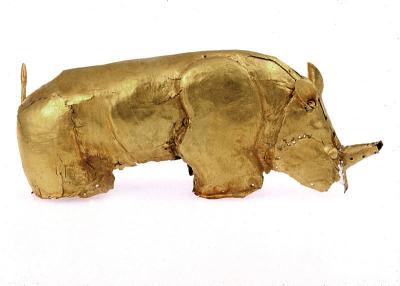
The golden rhinoceros of Mapungubwe, a small wooden animal covered in gold dating back a thousand years, was discovered in 1932 in a royal grave in modern-day South Africa.
It is the first sign of a class-based society in southern Africa, but also a clear indication of the rhino’s association with sacred leadership. The rhino’s qualities, its danger, aggression, power and perhaps unpredictability were seen as qualities that tribal chieftains wanted to project.
But why is the rhino apparently so often in a bad mood? One African folktale suggests he’s jealous of his friend, the giraffe. During a terrible drought, the grass became parched and bitter and the giraffe, which had a normal neck, was always trying to reach for the higher, fresh, green leaves on the bushes and trees. The rhino would laugh at his friend’s futile attempts -- until an old man fed the giraffe a special herb that allowed his neck to grow. The giraffe had the last laugh, and the rhino is still grumpy about it to this day.